
The Internal Security Organisation (ISO) has taken over Uganda’s wetland fish farming project.
By Bicholin K Musisi
The government has transferred management of its wetland fish farming project from the Ministry of Water and Environment to the Internal Security Organisation (ISO), following years of stagnation that left farmers frustrated.
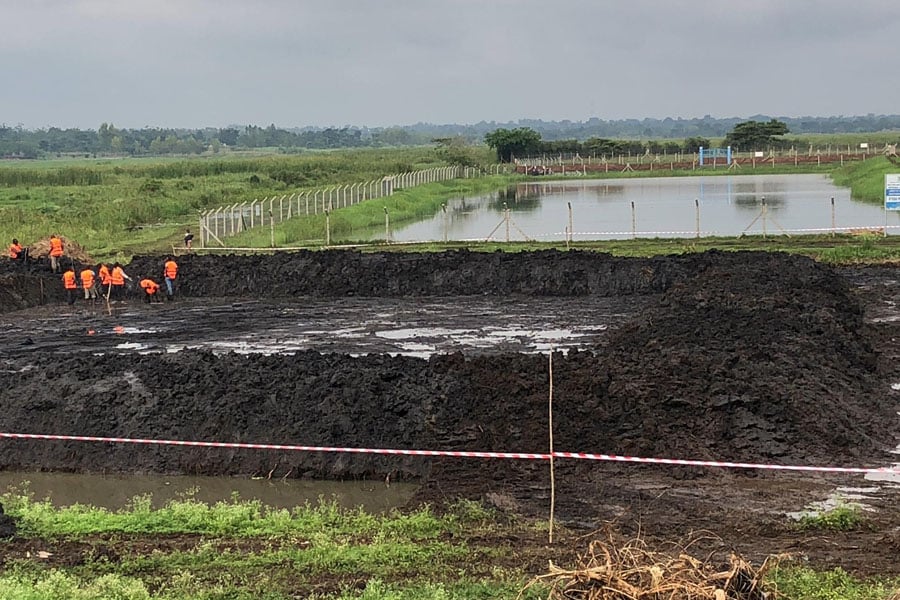
Under the new arrangement, ISO will oversee the establishment of 100 fish ponds along degraded wetlands, aiming to provide alternative livelihoods for communities previously reliant on wetland rice cultivation.
The Limoto Wetland Restoration Initiative, launched in 2018 to combine wetland restoration with income generation through fish farming, failed to deliver meaningful results.
According to Sirag Gashodo, chairperson of the Limoto Fish Farmers Association of 81 members, only a few ponds were operational, leaving farmers with minimal returns.
The first three harvests earned Shs67 million, Shs35 million, and Shs51 million, much of which was reinvested.
“Many grew frustrated, with some abandoning the initiative and returning to rice cultivation,” Gashodo said.
To revive the project, the government has partnered with Semuda Fish Farming Enterprise, managed by Maj David Muwanga Kibirango, to expand operations with 100 additional ponds, 10 of which have already been excavated since July 2.
“We are running several sites in the eastern region, with 50 ponds in Namutumba, another 50 in Budaka, and more planned for Kigezi,” Kibirango said.
Lt Col Frank Banana, ISO director in charge of mobilisation, described it as a presidential-sanctioned operation to boost wetland restoration and livelihoods in Busoga, Bukedi, and Kigezi.
“We are working with stakeholders like Nema [National Environment Management Authority], the Ministry of Water and Environment, and district authorities to build farmers’ capacity to coexist with wetlands through best practices in fish farming,” he said.
Banana highlighted the economic advantage of aquaculture over rice cultivation, noting that while an acre of rice generates about Shs1.05 million over seven months, fish farming can yield up to Shs29 million in the same period, with less labor intensity.
Despite earlier setbacks, government officials insist the new phase will transform livelihoods, providing viable alternatives for thousands of farmers displaced from traditional rice growing while advancing wetland restoration across the country.
The government's decision to entrust ISO with the wetland fish farming project raises questions, especially considering the UPDF Fisheries Protection Unit (FPU) has been managing fisheries enforcement since 2017.
The FPU's mandate includes curbing illegal fishing and promoting sustainable practices on Uganda's lakes.
Given its established role, many would have seen since in FPU being entrusted with this project as it would be like an extension of their mandate.
But the shift to ISO smells fishy whichever way you look at it. A spy agency managing fish farming? A coat for a goat indeed!